
Stella Welcome Days 2026
mehr lesen
04.03.2026
The Dark Side of Venetian Opera: Demonological writings, librettos, and layered source relations in seventeenth-century Venice
An interview with Dr. Sara Elisa Stangalino (FWF project lead, Stella Musikhochschule)
Project at a glance
Title: The Dark Side of Venetian Opera: Demonological Undercurrents in Seventeenth-Century Librettos
Duration: 48 months (start: 06/2025)
Funding: Austrian Science Fund (FWF)
Principal investigator: Dr. Sara Elisa Stangalino
Seventeenth-century Venetian opera was not only a site of musical innovation, but also a widely accessible form of public entertainment. Its librettos often engaged with literary, philosophical, and religious discourses of the time. Dr. Sara Elisa Stangalino’s FWF-funded project investigates, for the first time systematically, how Venetian opera librettos relate to demonological literature, with a particular focus on writings concerned with witchcraft, magic, and demonic belief. The research is based on the analysis of more than 400 surviving Venetian librettos and compares their thematic motifs with contemporary demonological texts.
Stella Forschungsservice: Dr. Stangalino, for readers who may not know the project yet: what is the core question you are pursuing?
Sara Elisa Stangalino: The project examines the relationship between demonological literature and seventeenth-century Venetian opera librettos. Venetian opera reached a broad public and librettos were highly responsive to contemporary debates. Therefore, my research asks how some of the main themes relating to demonology — especially those found in treatises and inquisitorial writings — can be traced, compared, and interpreted in relation to our understanding of dramaturgical patterns and recurring motifs in musical drama.
Stella Forschungsservice: What does your source corpus look like, and what kinds of materials do you bring into comparison?
Sara Elisa Stangalino: A comparison of treatises on demonological subjects and librettos will characterize the four-year project. The backbone of the project is a corpus of more than 400 surviving Venetian librettos from the seventeenth century, which are read alongside demonological treatises that circulated in early modern Europe.
After an initial phase, some interesting data emerged from the study of similar primary sources, namely the codices of practical magic that circulated during the Renaissance. I refer, for example, to the Liber incantationum, exorcismorum et fascinationum variarum held in the Munich library (BSB Clm 849), which contains detailed descriptions of necromancy rites. The same can be said for some books by Cornelius Agrippa (Of Occult Philosophy, Book Four: Magical Ceremonies) and Johannes Wier (De praestigiis daemonum). The research will be enriched with similar sources.
Stella Forschungsservice: A central reference point in your project is Jean Bodin’s Démonomanie des sorciers (1580). What is important for your work about its reception?
Sara Elisa Stangalino: The studies by Michaela Valente (Bodin in Italia) confirm that Jean Bodin’s Démonomanie was read throughout Europe despite it being placed on the Index of Prohibited Books. This has confirmed and consolidated one of the fundamental assumptions of my research.
Stella Forschungsservice: Your work also highlights that a direct »treatise–libretto axis« is not always sufficient. What changes when you extend the model?
Sara Elisa Stangalino: There is currently a growing need to consider not only the »treatise–libretto« axis but also the function of the declared literary antecedents of the musical drama sometimes cited in the paratexts of librettos (for example poems, references to ancient history). This means extending the »treatise–libretto« axis to a »treatise–literary antecedent–libretto« triangulation.
One of the main problems is that the relationship between treatise, declared literary antecedent, and libretto is not linear but is often the result of contamination in multiple directions. That librettos draw material from various types of sources is a characteristic feature of musical dramas in the Baroque era.
Stella Forschungsservice: Could you give an example of how this triangulation works in practice?
Sara Elisa Stangalino: One example is the librettos centred on the figures of Armida and Ismeno, magicians in Torquato Tasso’s Gerusalemme liberata. Tasso wrote in Ferrara in the court of the Este family; Ercole Cato, Bodin’s translator, was secretary to Ippolito II d’Este. We know that Tasso and Cato worked closely together, and it remains doubtful that Tasso did not read Jean Bodin’s Démonomanie (in support of this hypothesis see A. Solerti, Vita di Torquato Tasso; Gerusalemme Liberata, edited by C. Varese and G. Arbizzoni, published by Mursia; the studies by Giuliana Picco (Studi Tassiani, 1992); and Lettera di Torquato Tasso ad Antonio Costantini, Roma, 12 January 1590).
A similar argument applies to the dramas centred on the figure of the sorceress Falsirena, borrowed from Cantos XII and XIII of Adone by Giovan Battista Marino. Marino draws both from folk tradition (and therefore from texts on demonological subjects — see the edition of Adone edited by E. Russo, published by Rizzoli) and from ancient sources, specifically from Lucan’s Pharsalia. We know that Marino was the favourite author of the members of the Accademia degli Incogniti who sponsored musical theatre in Venice. Even in this case, the connection between Lucan, Marino, demonological treatises, and musical drama is therefore complex and requires in-depth investigation.
Stella Forschungsservice: Finally, what is the broader relevance of this research — beyond opera studies?
Sara Elisa Stangalino: The research contributes to a deeper understanding of the interaction between opera and society. It shows how popular musical dramas could reflect contemporary beliefs and anxieties and how cultural ideas could be transformed in the process. The results are relevant not only for musicology, but also for cultural history, literary studies, and the history of religion. In addition, they offer new perspectives for the interpretation and staging of historical operas by making deeper symbolic and ideological layers visible.
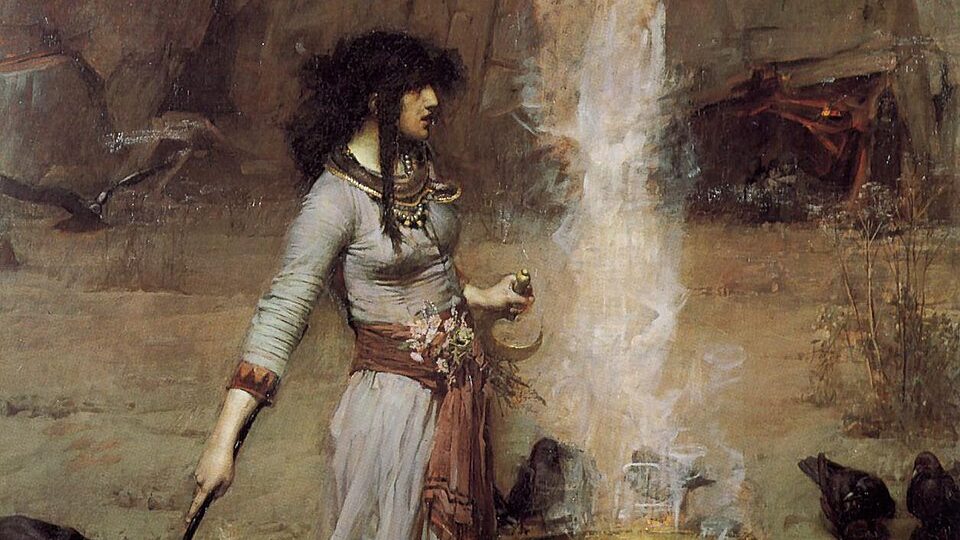
Bild: https://it.wikipedia.org/wiki/File:John_William_Waterhouse_-_Magic_Circle.JPG)